Note: in a previous version of this article, we estimated that the ads in Leeds consumed as much as 8,000 residents. After reviewing some of the assumptions and with the most up to date energy numbers, the total amount is about 3,300 residents. This difference is mostly because we now do not compensate for the fact that our database does not contain all ads in Leeds. Therefore, this value is most likely an underestimation of the real electricity consumption. You can find the article with the current numbers here.
If you’ve been walking/biking/driving/existing around the streets of Leeds at night, you have definitely come across illuminated ads: either on bus shelters, big digital billboards, simple 6-sheet on the pavements… And have you ever stopped to think how much electricity is wasted on telling you what to buy and how to be? At AdBlock Leeds, we have done the math. It turns out that the annual electricity used for advertising in Leeds is around 4.1 GWh. Given that the yearly electricity consumption of a median UK household is 2,864 kWh and that the average household size in Leeds is 2.34 people, you could power more than 3,300 Leeds residents with that electricity, or roughly 0.5% of the population.
Note that this is only the direct electricity use, or the electricity going to power the ad infrastructure. We have not taken into account any of the electricity associated with production, installation, maintenance, or any other actions associated with running ads. More importantly, this does not account for any of the energy use created by the ad message. If, after being bombarded by advertisement all around the city, people change their smartphones every second year, there is an electricity use associated with this overconsumption; that includes energy use from the manufacturing of new phones, shipping and disposal.
Disclaimer
This value is just an approximation of the direct electricity use of ads in Leeds. Ad companies are very secretive about their energy usage and it is also hard to get an updated list of all ads in the city. Our calculations show that the annual electricity consumption is somewhere between 1.5 and 6.7 GWh. It is a large range, but it does give a good order of magnitude of how much energy is wasted in trying to sell us stuff. We’ve made the process as transparent as possible, so anyone can review, replicate and provide feedback about our calculations.
More than 2,000 ads in Leeds
We used the website BubbleOutdoor to quantify the number of ads in Leeds. This website provides advertisers with a way to book advertising space all across the UK. For each advertising space available on that website, several characteristics such as price, location or availability are given. In our case, we focused on the location and type of infrastructure. In the example below, the ad type is “Digital 96”.
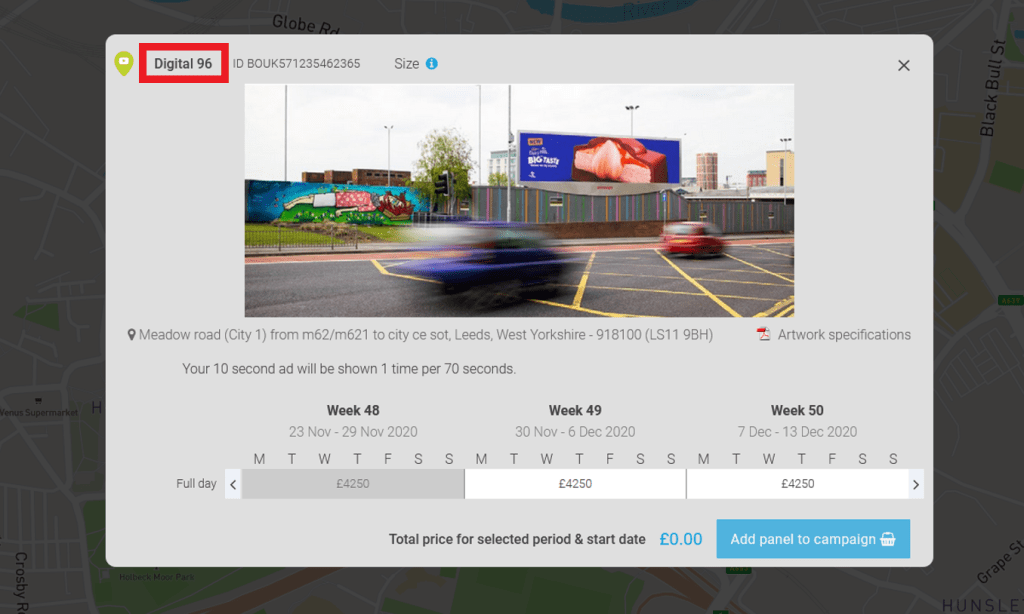
Limiting the search by LS postcode (for Leeds), we were able to establish how many ads of each type are available on the website. The numbers are given in the table below, with ads adding up to 2,057. However, the database on the BubbleOutdoor website is not complete, as we found several ads in Leeds that are not on their page. This means that there are actually more ads in Leeds than what we have in the table below.
| Type | Number of ads | Min [kWh] | Max [kWh] |
| Backlit 48-sheet | 31 | 6,101 (2.1) | 6,101 (2.1) |
| Backlit 96-sheet | 8 | 12,203 (4.2) | 12,203 (4.2) |
| Cinema 6-sheet | 57 | 3,208 (1.1) | 16,830 (5.9) |
| Digital 48-sheet | 2 | 41,656 (14.5) | 138,853 (48.5) |
| Digital 6-sheet | 58 | 3,208 (114) | 16,830 (5.9) |
| Digital billboard | 5 | 41,656 (14.5) | 138,853 (48.5) |
| Large portait panel – 350 | 1 | – | – |
| Paper 96-sheet | 23 | 762 (0.3) | 762 (0.3) |
| Phonebox | 390 | 0 (0) | 10,694 (3.7) |
| Screen in BP station | 1 | 486 (0.2) | 745 (0.3) |
| Screen in Shell station | 9 | 486 (0.2) | 745 (0.3) |
| Scrolling 6-sheet | 121 | 1,017 (0.4) | 2,034 (0.7) |
| Shopping centre furniture | 1 | – | – |
| Static 16-sheet | 7 | 0 (0) | 2,542 (0.9) |
| Static 48-sheet | 295 | 0 (0) | 7,626 (2.7) |
| Static 6-sheet | 1,048 | 263 (0.1) | 526 (0.2) |
The next step was to evaluate how much electricity each of these types of ads consumes. Again, it is tricky to find the measures for that, because ad companies don’t always publish them. We did our best to come up with reasonable maximum and minimum estimates. The details behind the estimates are given at the end of the post. Note that we left out “Large portrait panel” and “Shopping centre furniture” ads as we could not find relevant data for them.
Now that we know how many of each types of ad there are in Leeds and how much each of them consumes, we can just add up the numbers. We find that the total direct electricity consumption by ads infrastructure in Leeds is between 1.5 and 6.7 GWh.
So now you know: the advertising infrastructure in Leeds uses as much electricity as about 0.5% of the total population. This is enormous, ridiculous and totally unnecessary in times of a climate crisis. Join AdBlock Leeds, help us end this nonsense and let’s reclaim our public spaces together!
Consumption of each type of infrastructure
This section is just here to enable anyone to double-check our results and assumptions. If you find it boring, just skip it!
Static 6-sheet
A static 6-sheet on a bus stop has 3 light bulbs of 20 W each. Over one hour, that is 3*20=60 Wh. Over a year, that is 24*365.25*60=525.96 kWh
Some stops are only on during the day. For those, the yearly consumption of energy is 262.98 kWh
It not possible to know which ones are on all the time and which ones are off at night. For max, we assume all are on during the night. For mean, we assume none are.
Max = 525.96 kWh
Min = 262.98 kWh
Scrolling 6-sheet
On the Leeds city council planning application document, application 13/05024/ADV is for a scrolling 6 sheet. The technical specifications state that the panel has 4 tubes of 58 W. Over a year, the energy consumption is therefore 4*58*24*365.25 = 2033.712 kWh
There is no indication as to whether the lights are only on at night. If we assume that they are, the consumption is 1016.856 kWh. Max is if ads are on at night, min if they are not
This does not account for the energy consumed by the motors that rotate the ads.
Max = 2033.712 kWh
Min = 1016.856 kWh
Static 48-sheet
According to 12/02597/ADV, an internally lit static 48 sheet has 15 tubes of 58 W each, so 870 W. That is 7 626 kWh per year. It is not possible to know which are lit and which are not, so as a max value we assume they all are, as a min value we assume none are
Max = 7 626 kWh
Min = 0
Phonebox
There are two types of phone box adverts: paper and digital. We don’t have data on which are which, but on the bubble website it seems like paper ones generally cost 61£/week and digital ones are more expensive (with varying prices). To assess how many of each type there are, we look at the price.
The digital ones seem to be close to 6-sheet digital, see pic
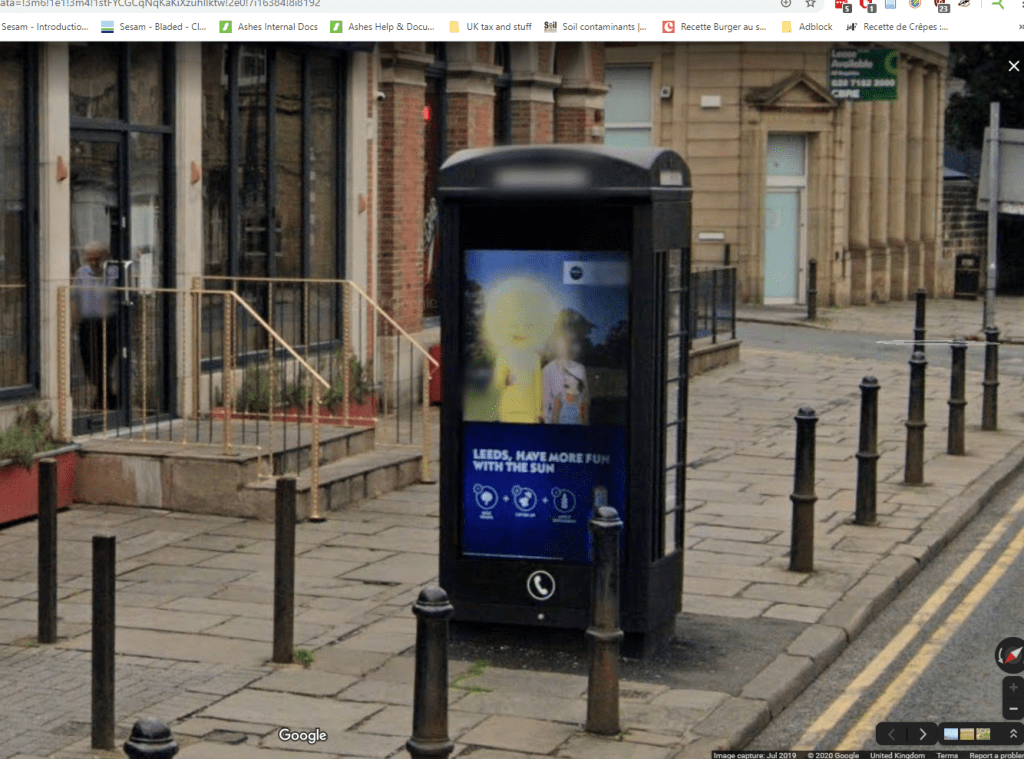
For digital, we assume the same think as 6-sheet digital single side
Max = 10694 kWh
Min = 3 208 kWh
For paper ones, we assume 0
Backlit 96-sheet
We assume the consumption of a Backlit 96-sheet to be twice that of a Backlit 48-sheet
Max = 12202.272 kWh
Min = 12202.272 kWh
Paper 96-sheet
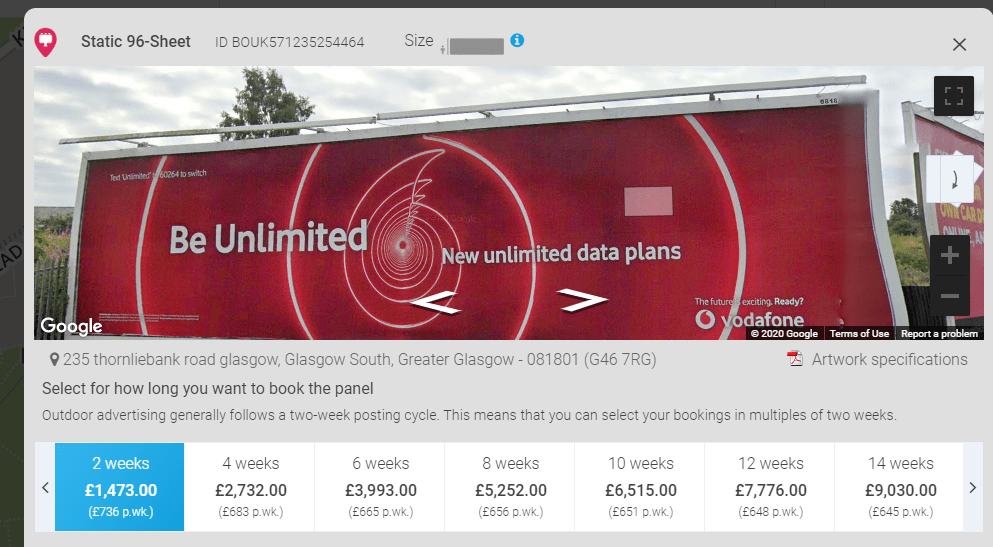
These ads have lighting for nights. They are 6 m long, so they probably need 3 tubes. We assume they use 58 W tubes, and that they are only on half the time.
Max = 762.642 kWh
Min = 762.642 kWh
Mega 6
No data, we assume 0
Bridge Span
No data, we assume 0
Backlit 48-sheet
Application 11/01404/ADV in the Leeds website states that the power consumption is 1392 W, and that the billboard is only on at nights. The energy consumed in a year is therefore 1392*24*365.25/2 = 6101.136 kWh
Max = 6101.136 kWh
Min = 6101.136 kWh
Scrolling 48-sheet
We assume 8 times the scrolling 6 sheet
Max = 16269.696 kWh
Min = 8134.848 kWh
Backlit Mini-Billboard
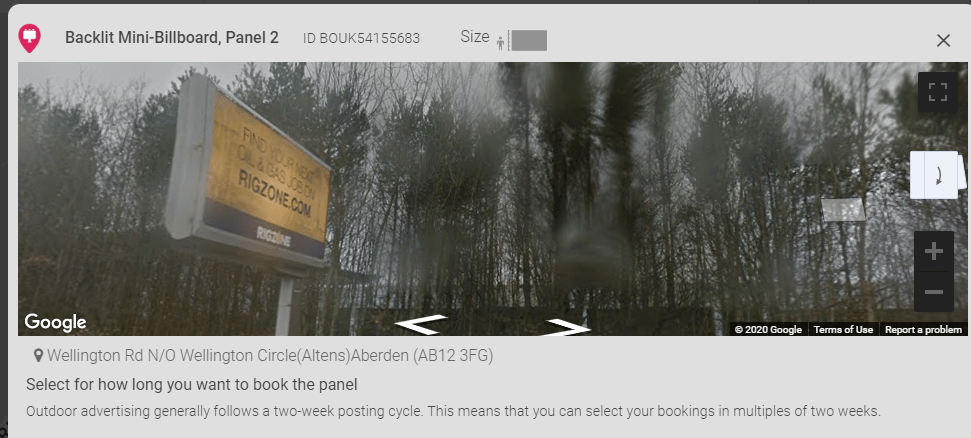
From the bubble website, this ads seems to be about 2*3 m approx, and they are backlit. Since 48 sheet is 3*6, we assume a third of the consumption of a 48 sheet
Max = 2033.712 kWh
Min = 2033.712 kWh
Moving 48-sheet
No data, we assume 0
Paper 16-sheet
We assume a sixth of 96-sheet
Max = 127.1 kWh
Min = 127.1 kWh
Sheffield City Centre package
No data, we assume 0
Shopping centre furniture
No data, we assume 0
Cinema 6-sheet
Our experience is that all 6-sheet in cinemas are digital, so we take max as the max consumption of digital 6 sheet double sided, and min as the min of single sided.
Max = 16 830 kWh
Min = 3 208 kWh
Static 16-sheet
We assume a third of Static 48-sheet
Max = 2 542 kWh
Min = 0
Large Portrait Panel – 250
No data, we assume 0
Large Portrait Panel – 350
No data, we assume 0
Static 32-sheet
We assume twice static 16-sheet
Max = 5 084 kWh
Min = 0
Billboard
I cannot find any information about what these billboards might be. It seems like billboard is generally used for 48-sheet, so for max we use max of a digital, for min we use 0
Max = 138853.4 kWh
Min = 0 kWh
Railway Station 4-sheet
We assume 2/3 of the 6 sheet
Max = 350.64
Min = 175.32
Railway Station 6-sheet
This pic from the Bristol Temple Meads Railway Station shows a 6-sheet lollypop. We assume that is what these ads are

This is a static 6-sheet, so we assume the same consumption
Max = 525.96 kWh
Min = 262.98 kWh
Railway Station 48-sheet
We have no info. We assume that the maximum is max for digital and min is min for static
Max = 138853.4 kWh
Min = 0 kWh
Railway Station HD48-sheet
Since it’s HD, we assume it’s digital
Max = 138 853.4 kWh
Min = 41 656 kWh
Railway Station 16-sheet
We assume 12 sheet + 4 sheet
Max = 1402 kWh
Min = 701 kWh
Railway Station 12-sheet
We assume twice the 6-sheet
Max = 1051.92 kWh
Min = 525.96 kWh
Screen in BP Station
According to the bubble website, this is a 53*30cm screen

According to https://www.samsung.com/uk/tvs/qledtv-q60r/QE55Q60RATXXU/, a 55 inch TV has a max power consumption of 170 W (so 1 490 kWh annually) and a typical of 111 W (so 973 kWh). We assume these are on half the time
Max = 745 kWh
Min = 486 kWh
Screen in Shell Station
We assume same as for BP
Max = 745 kWh
Min = 486 kWh
Banner
No data, we take 0
Vinyl 48-sheet
No data, we take 0
A3 portrait in changing room
No data, we take 0
InLinkUK
An InLink has two 55-inch screens (see application 18/07503/ADV)
According to https://www.samsung.com/uk/tvs/qledtv-q60r/QE55Q60RATXXU/, a 55 inch TV has a max power consumption of 170 W (so 1 490 kWh annually) and a typical of 111 W (so 973 kWh).
Max = 1 490 kWh
Min = 973 kWh
Digital Billboard
ID BOUK572000138225 is for a digital billboard and shows that the considered ad is a digital 48-sheet.
Max = 138 853.4 kWh
Min = 41 656 kWh
Digital 6-sheet
See digital 6 sheets
Max = 16 830 kWh
Min = 3 208 kWh
Digital 96
For digital 96 sheet, we take twice digital 48 sheet
Max = 277 706 kWh
Min = 83 000 kWh
Digital 48 Sheets
According to 19/07383/ADV in Leeds, the max consumption of a digital 48 sheet is 15 840 W, so 138 853.4 kWh per year. The typical consumption is 4752 W, so 41 656 kWh per year
Max = 138 853.4 kWh
Min = 41 656 kWh
Digital 6 Sheets
According to 20/00340/A on the Bristol council website (https://planningonline.bristol.gov.uk/online-applications/applicationDetails.do?activeTab=documents&keyVal=Q4MCPDDNHX600).
According to that application, the max consumption for a double sided ad is 1920 W (no typical consumption given), so 16 830 kWh per year. We assume that the ratio maximal/typical is the same as for Digital 48 sheet, so 3.33. Therefore, typical consumption for a double side is 5 051 kWh. The max consumption for a single sided is 1220 W, so 10 694 kWh per year. With a 3.33 ratio, the typical is 3 208 kWh. We don’t know which ads are double side and which are single. As a max, we take max for double sided, and as a min we take min for double sided
Max = 16 830 kWh
Min = 3 208 kWh
Rail Digital 6 pack
The Rail digital packs are packs with a number of 6-sheet digital. For example
208245,Rail Digital 6 pack,”Glasgow Central Station – 7x digital 6sheets”,5886,BOUK52STN122
has 7.
When checking all addresses (there are 109 in total), we obtain that there are 529 6-sheet in total (see Station addresses in the Excel file)
We use the values for digital 6-sheet
Max = 16830 kWh
Min = 3208 kWh
Railway Station scrolling 6-sheet
We assume normal scrolling 6-sheet
Max = 2033.712 kWh
Min = 1016.856 kWh
Shopping Centre
Shopping Centre Furniture
 AdBlock Leeds
Leave a comment